Text can be so familiar, so comforting, and in many ways we forget this. Or sometimes we just don’t take advantage of this relationship we have with text, with known texts, with those texts we love and those we have loved, but have perhaps forgotten. Like things read in childhood, memories forged between the covers of a book, or borne in hearing, for the first time, a poem read aloud. Words that took your head in their hands and made you take notice.
Of course sometimes we read things over and over again, searching for that deeper meaning that we suspect to has eluded us up until that point. We read deeper into each story or poem that we are drawn back to, we look for what we have missed. Two summers ago I read ‘The Lovesong of J. Alfred Prufock’ aloud to myself every day for a month, revelling in the richness of the language, its surprises and buried meanings. And I’m always drawn back to some essays, like Gaston Bachelard’s phenomenological work on shells in The Poetics of Space. I fantasise that I might finally grasp his thoughts as he wrote completely, but still I am always surprised, always arrested, and usually slightly confused. Sometimes things just need a little time, a little time to work through your head, some time to settle before firing themselves up again.
But not everyone has the same relationship with writing, or reading for that matter. One of the most interesting things about China is the way in which those who are truly dedicated to poetry demonstrate their dedication. Chinese poetry has something that poetry in English can never hope for, can never even dream of, and that is the extra dimension offered by the language and its immense and intricate set of characters. For all of its complexity though, Chinese poetry is usually very subtle. Sometimes reading a translation of a Chinese poem, it feels almost too subtle, as if perhaps you’re missing out on something. Well, you are missing out on something.
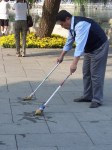
Where we might read a poem over and over again absorbing its meaning, sounds and nuances, a Chinese poetry lover might write the poem over and over again. And this is not a private act, he will not sit in a room, writing with pen on paper, filling a notebook, every page with the same poem. Rather he will take himself to the park with a bottle of water and a large brush called a 毛笔 (máobǐ) and there he will write poetry on the paving slabs around him using water, and those words written in water will slowly evaporate under the hot Chinese sun.
Often he will write poems he has known his whole life, poems he learned in school, ancient poems, Communist poems, poems that he likes and poems that he loves. He will write them over and over. He not only knows the meaning and sounds by heart, but he knows the shape, he knows where a character ends and another begins, he knows each flick and dart of the wrist that is needed to make each word, and he knows, instinctively, the movements that exist between the characters, those movements in the white space that leave no mark.
For a retired man, a lover of poetry and of calligraphy, this may be how he spends the whole day, it may be how he spends spring, summer and autumn. In winter, in the north, it is too cold to write poetry with water. His ink would turn to ice. And in the summer, when the rains come, a poem might be ruined by an unexpected rain shower, but this doesn’t matter. He’ll write the same poem again tomorrow when it clears.


 Duncan Stewart Muir