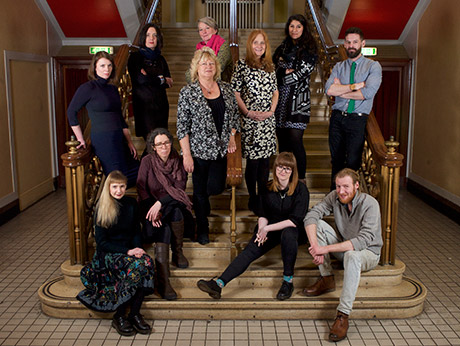
I am truly honoured to have received a New Writers Award for poetry from the Scottish Book Trust. Really looking forward to working with all the awesome bookish people down their wee lane in Edinburgh and the rest of the New Writers Awardees.
I am truly honoured to have received a New Writers Award for poetry from the Scottish Book Trust. Really looking forward to working with all the awesome bookish people down their wee lane in Edinburgh and the rest of the New Writers Awardees.

My poem ‘The Hutch’ has been published in the latest issue of the transatlantic poetry magazine, The Dark Horse.


St Mungos Mirrorball – Clydebuilt 8 showcase will be on Thursday 5th May at 7pm in the Club room at the CCA.
This year’s Clybebuilt mentor Gerry Cambridge showcases the work created by the group in the last year
Gerry Cambridge is a poet, essayist and editor, with a substantial interest in print design and typography as well as a background in natural history photography. His publications include Notes for Lighting a Fire (HappenStance Press, 2012), Since 1995 Gerry has published and edited The Dark Horse.
Henry Bell is a writer, editor, and events organiser based in Glasgow. He the managing editor of Gutter, Scotland’s magazine of new writing, and has edited a number of books including A Bird is Not a Stone, an anthology of contemporary Palestinian poetry in the languages of Scotland.
Duncan Stewart Muir undertook his MLitt in Creative Writing at The University of Glasgow, graduating with distinction in 2010. Duncan’s poetry has been published in Poetry Review, PN Review, New Writing Scotland, Blast Furnace and In Protest: 150 Poems for Human Rights. He lives in Glasgow where he is at work on his first novel, Our Affliction, set in the Far Eastern borderlands between China and Russia.
Nalini Paul’s first poetry pamphlet, Skirlags, was shortlisted for the Callum Macdonald Award in 2010. She was George Mackay Brown Writing Fellow in Orkney, and has collaborated on projects and commissions for stage and film. Her current poetry book, The Raven’s Song, is inspired by raven-and-crow myths from Orkney, Shetland and Canada.
Gregor Addison teaches English at West College Scotland and lives in Scotstoun, Glasgow. His poetry has previously been published in Carcanet’s Oxford Poets 2013: An Anthology (EDITED BY Iain Galbraith and Robyn Marsack), as well as in Gairm, The Edinburgh Review, Chapman, New Writing Scotland, Gath, Causeway/Cabhsair, The Dark Horse and Gutter.

My poem ‘Notes for Surviving’ has just been published in the latest edition of New Writing Scotland. It’s got some great company, I’m particularly looking forward to reading the title story by my old University of Glasgow classmate, Carol Farrelly.
I’ve spent the last three years in China swearing blind that I only write about gruesome beauty and that my poetry is never political (admitting to being a political poet in China is never a good idea). This is a position I’ll now need to revise.
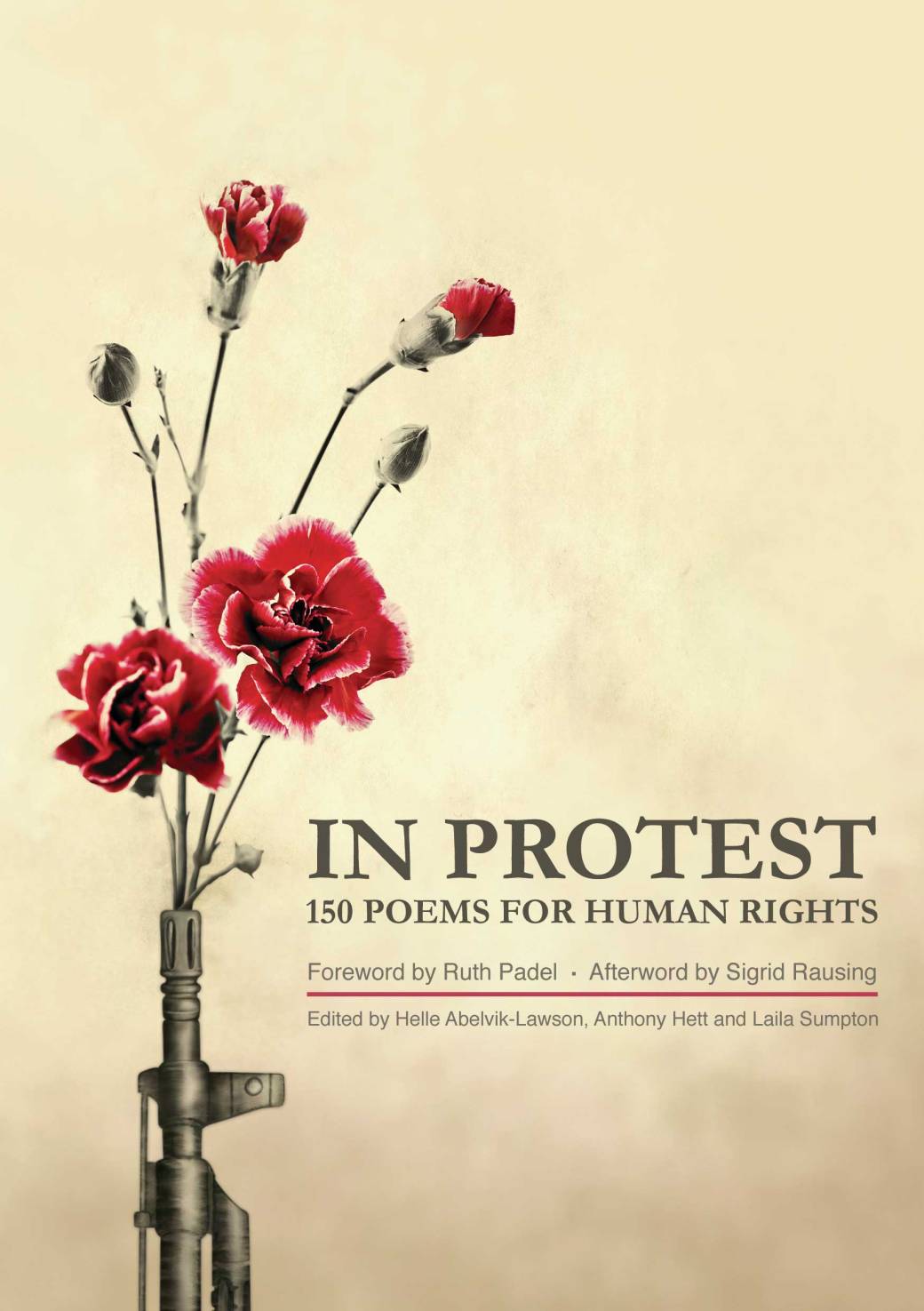
My poem, ‘Choeung Ek’ has just been published in ‘In Protest: 150 Poems for Human Rights, the anthology also has work from The Poet Laureate, Ruth Padel, and many other fantastic poets.
My poems, ‘Gui Jie, Beijing’ and ‘fòid mòna’, part of ‘The Boglands’, a sequence on peat, have now been published in PN Review issue 210. The magazine is available in all good bookstores and online at www.pnreview.co.uk.

Sometimes a piece of writing lingers unfinished for a long tim e, weeks, months, sometimes years. When such pieces are finally finished it feels a little strange, then it lingers again while you work out what to do with it, whether to put it out there or let it hide. Not all finished poems should be published. But, I am happy to say that one of my lingerers has been published this week by Blast Furnace, an independent publisher based in Pittsburgh, Pennsylvania. Blast Furnace publishes poetry that is deeply rooted in place, as many of my poems are. You can read ‘The Harvester’ in Volume 2, Issue 1 on their website, alongside some great work in form by more established writers.
Sometime in early November the daytime temperature in Dongbei dipped below freezing covering all of the windows in my apartment with a thin sheet of ice. The ice grew thicker each day until it overgrew the glass of the windows and froze each casement closed. For four months I have seen the world through ice. In daytime, this is a bright, brilliant place, for Dongbei skies are usually clear and cloudless. The sunlight shines through the windows refracting over the patterns made in the glass. These patterns grow in tiny florets and whorls and arabesques of icy foliage, as if the ice itself is alive and multiplying through something more than just the cold. It’s not easy to see through a frozen window, and less light comes in, but at night the ice crystals glitter in the moonshine, encrusting the glass with diamante sparkles.


In these icy months, I’ve been thinking not only about how I view the bright but distorted outside on the other side of the frozen glass, but also how we experience the distant but intimate world on the other side of the page of an unfinished novel. A novel in progress is like a series of frozen windows, a chain of necessary scenes. We may have a firm idea of the structure in each pane, but these structures grow and change. In the cold of night ideas harden and become crisp, but during the day they are thawed by sunlight, and when they refreeze the patterns change. When the pattern in one window grows, so too must the pattern in each of the other frames, and the novel, like the ice on the windows, is growing in countless directions all at the same time.
You can read a metaphor in a hundred different ways, and the same is true of many stories, but there is a story that I feel demonstrates this relationship between the writer and his work so completely. Gabriel Josipovici’s ‘Second Person Looking Out’ is a surreal tale in which the protagonist is visiting a house with seventeen rooms with three windows in each. In the story, each time a window is used, it moves, so the characters are constantly disarmed by their own viewpoint:
If you go from one room to another, he says, the head of the house, your host, may move a window fractionally along the wall or transplant it to another wall altogether, so that when you return to the first room you see another landscape outside, differently framed.
Josipovici’s story is haunting and confusing, and in so many ways, once you have spent a long time writing a text, viewing it from so many angles, through so many frames, the text also becomes confusing. But we continue. We continue because of the possibilities, for the pleasure of what the next window might hold, for the surprises waiting there, and the challenges. Not every window will be used, not every frame. Some will thaw completely, their patterns will dissipate to mere fog, while others will earn their permanence.
‘Second Person Looking Out’, despite its title, doesn’t just look out from the house with its seventeen rooms and shifting window frames, the protagonist is also journeying to and from the house upon a network of winding paths. The house itself seems to move, flirting with the viewer, and the reader:
First you may see a little bit of the house, then it disappears for several minutes, then you see another aspect of it, because the path is winding gradually round it. And when you finally reach it, because you are constantly seeing fragments of it and imagining it when you can’t see it, you’ve experienced it in a million forms, you’ve already lived in the house, whole dramas have occurred before you even reach it, centuries have elapsed and you are still as far away from it as ever.
This house, like the novel, is a world we must circle around in order to find the best viewpoint, the surest entrance, for not all of the routes into a work are created equal. This is a long game, but we must be willing to turn it in our minds, we must be willing to make the most of these moving windows, of their ice and its thaw. We must always be looking for the perfect view and the crispest pattern.
Gabriel Josipovici; ‘Second Person Looking Out; Heart’s Wings and Other Stories (Caracanet; 2010)
Text can be so familiar, so comforting, and in many ways we forget this. Or sometimes we just don’t take advantage of this relationship we have with text, with known texts, with those texts we love and those we have loved, but have perhaps forgotten. Like things read in childhood, memories forged between the covers of a book, or borne in hearing, for the first time, a poem read aloud. Words that took your head in their hands and made you take notice.
Of course sometimes we read things over and over again, searching for that deeper meaning that we suspect to has eluded us up until that point. We read deeper into each story or poem that we are drawn back to, we look for what we have missed. Two summers ago I read ‘The Lovesong of J. Alfred Prufock’ aloud to myself every day for a month, revelling in the richness of the language, its surprises and buried meanings. And I’m always drawn back to some essays, like Gaston Bachelard’s phenomenological work on shells in The Poetics of Space. I fantasise that I might finally grasp his thoughts as he wrote completely, but still I am always surprised, always arrested, and usually slightly confused. Sometimes things just need a little time, a little time to work through your head, some time to settle before firing themselves up again.
But not everyone has the same relationship with writing, or reading for that matter. One of the most interesting things about China is the way in which those who are truly dedicated to poetry demonstrate their dedication. Chinese poetry has something that poetry in English can never hope for, can never even dream of, and that is the extra dimension offered by the language and its immense and intricate set of characters. For all of its complexity though, Chinese poetry is usually very subtle. Sometimes reading a translation of a Chinese poem, it feels almost too subtle, as if perhaps you’re missing out on something. Well, you are missing out on something.
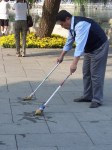
Where we might read a poem over and over again absorbing its meaning, sounds and nuances, a Chinese poetry lover might write the poem over and over again. And this is not a private act, he will not sit in a room, writing with pen on paper, filling a notebook, every page with the same poem. Rather he will take himself to the park with a bottle of water and a large brush called a 毛笔 (máobǐ) and there he will write poetry on the paving slabs around him using water, and those words written in water will slowly evaporate under the hot Chinese sun.
Often he will write poems he has known his whole life, poems he learned in school, ancient poems, Communist poems, poems that he likes and poems that he loves. He will write them over and over. He not only knows the meaning and sounds by heart, but he knows the shape, he knows where a character ends and another begins, he knows each flick and dart of the wrist that is needed to make each word, and he knows, instinctively, the movements that exist between the characters, those movements in the white space that leave no mark.
For a retired man, a lover of poetry and of calligraphy, this may be how he spends the whole day, it may be how he spends spring, summer and autumn. In winter, in the north, it is too cold to write poetry with water. His ink would turn to ice. And in the summer, when the rains come, a poem might be ruined by an unexpected rain shower, but this doesn’t matter. He’ll write the same poem again tomorrow when it clears.


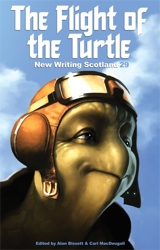 My poem, ‘The Peat God’, has just been published in The Flight of the Turtle, an anthology of Scottish prose and poetry. The book is available from Amazon and in all good Scottish bookstores.
 Duncan Stewart Muir